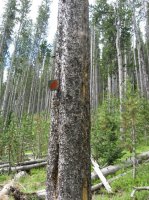
To continue with Venchka's advice, looking at Forest Service maps, and Google Earth, you can see that the trail continues west to Forest Service Road 82, which travels in a roundabout way north-south, eventually leading to other logging roads, skids roads, and eventually to the CDT. That is one option.
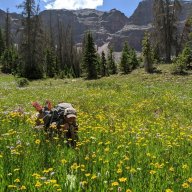
Another option is to head north from Buffalo Lake, either staying on the plateau west of Boundary Creek or dropping down into the valley bottom, and heading north (up) the Boundary Creek drainage. This keeps you in the park.
Once you reach the plateau that the Summit Lake (CDT) trail runs along, you have a couple of choices. Either follow the base of the plateau northwest until you cross the CDT or you can hike up onto the plateau and continue north or NNE, which will lead you to the CDT within a couple miles. The plateaus in that country are easy traveling, the forest is, for the most part, relatively open. The section of the CDT that I have been on (east of Summit Lake) is easy to spot if you are coming onto it from a north or south direction. This route requires good orienteering skills.
The topos you are looking for are the Buffalo Lake and Buffalo Lake NE (1:24,000). For what it's worth, my preferred website is
https://ngmdb.usgs.gov/maps/TopoView/viewer/#12/44.3758/-111.0641
Click on the Topo map icon in the upper left corner, and the 1:24000 Map Scales option along the right side and you'll be good.
You can also go on the Caribou-Targhee NF website and find the Ashland-Island Park Ranger District Park Summer Recreation Opportunities map that shows the FS roads and trails in that area.