How would it affect the water shed and those who rely on the reserve of water?
It depends on who you ask. That last link on USA Today has some pretty good stats and info from both sides. Pro-dam people say that Powell is better storage because it is higher elevation than Mead and therefore wouldn't evaporate as much because of cooler temps. Others say that Mead is a better storage reservoir because it is more bowl-shaped and less porous rock with a fraction of the shore line and side canyons. Years ago the BoR figured Powell is losing something like a million acre feet of water a year to evaporation and 'bank storage' from water that leaks into the porous navajo sandstone. That's about 4 million households worth of water for one year, worth about $1 billion in southern California (from the article I read). LP's full water capacity is 24 million af and Mead's is 26 million.
If it ever does come down, there will be a lot of sad boaters.
Yeah, there would be a lot of sad boaters and people would no doubt be pissed. A pretty big industry of tourism and houseboat rentals would also die. I don't know if you've ever cruised past the slips at Wahweap or Antelope Point, but WOW. LOTS of money down there.
And what would the expense be to blast it all down and haul out all that cement?
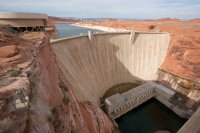
No clue, but it cost about $325 million to remove the Glines Canyon Dam, the largest dam removal to date. Glines was 210 feet high. Glen Canyon Dam is 710 feet high and 300 feet thick at the base! I don't know if it's possible, but I wonder if there's some way to just reopen the diversion tunnels?
Videos of Glines Canyon going down:
The quagga mussel problem is another reason I feel extra compelled to knock that sucker down. As the quaggas reproduce and take over all of the submerged surfaces, it's going to start getting really ugly when the water drops. I've heard reports that you can see them on the walls in the Castle Rock Cut right now (I forgot to look when I was there). There was a also a news story a couple months ago that a couple found a GoPro scuba diving and found the owner. It had been in the lake for 6 months and was already covered in mussels. Just a few weeks ago the UDWR biologist down there caught a mussel on his fish hook. I have this fear that the mussels will go crazy and cover the walls, then when the water drops like it is right now, instead of that ugly bathtub ring, we'll all be staring at rock walls covered in billions of mussels. If that were to happen, and then even if you drained the whole lake, how long would it take for canyons to recover if the walls were lined with mussels? And even if you didn't drain it, just natural fluctuation, will Lake Powell still be something even the recreational boaters would want to see then? Maybe just look up above the bathtub/mussel ring and try to ignore it? Maybe that's not how it works, but from what I understand, it's very much possible, if not likely.
Then the silt. According to Wikipedia:
About 100 million tons of sediment are trapped behind the dam annually, equal to about 30,000 dump truck loads daily.
Most of that silt is dropping where the Colorado dies, not at the dam, otherwise I don't think it would have ever been built. I've read anecdotal stuff online from folks who seem surprised and concerned by how shallow things are getting in the north end where the most build up is. Yeah, the lake is low, it's shallower, but not like that. It's getting shallower because it's getting 30,000 dump trucks of dirt dropped in and settled down every day. I've hiked some relatively minor side canyons like Cottonwood Gulch that had lake sediment piles as tall as a house with boater trash embedded 10 feet deep, only visible because the stream had been cutting away at the pile while the lake was low.