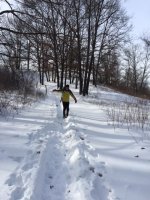
Don't make the same mistake I did several years ago when I was in your shoes! I headed out on a warm winter day (probably low/mid 40s and sunny) with just microspikes, and told myself I would just turn around if snowshoes were needed. The snow was hard packed and microspikes were perfectly sufficient... until about 4 miles in, when the afternoon sun hit and the snow started getting really soft. Post-holing my way back was one of the most brutal, and probably one of the more dangerous, hikes that I have done. Keep in mind that snowshoes may not be needed in the morning, but may be needed later in the day! (that sounds obvious, but somehow I didn't think through that carefully!)
Some more tips (I haven't read all the feedback here yet, so maybe these have been covered):
-It's all about layering, not about having a single warm coat/layer. If you get too warm, then you will sweat more and then that becomes dangerous if you stop or if the wind picks up. Experience will help you figure out the layering that works for you. Avoid cotton.
-For me personally, I don't need a lot of layers on any particular part of my body, but I do need to cover everything. The most challenging part is the face. I have both a balaclava and a buff and alternate between them depending on how cold it is. I would recommend having at least a balaclava though.
-My biggest on-going challenge in the winter is keeping my glasses/sunglasses/goggles from fogging. This is not only annoying but also dangerous. Cat Crap seems to help (you just wipe it on beforehand). I cut the mouth hole in my balaclava bigger and that really reduced the fogging. The downside is that more of the skin around my mouth is now exposed. I rub some vaseline over that skin before heading out, in attempt to add a blubber-like effect.
-Gaiters work wonders
-Hiking poles are awesome year-round, but are especially important in winter (use snow baskets with them). Costco sells good ones for fairly cheap.
-I use my light pair of glove liners more than my heavy mittens. Once I start hiking, I really warm up and don't need much on my hands most of the time
-Don't tie your boots too tight, and don't wear super-tight socks---looser fit will improve circulation and keep your feet warmer
-Don't forget sun protection stuff! I've forgotten my summer hiking hat (sun hat) a few times on winter hikes (because I was so focused on the warmth layers), and during warm parts of the day I really regretted it. Ditto for sunscreen, and especially sunglasses. Get some sunglasses with good peripheral coverage.
-Hydration tubes will freeze. Bring wide-mouth bottles (I often bring gatorade bottles or the like). Turn them upside down in your pack (after making sure they are sealed tight!) so that if they start to freeze, you can still drink from the mouth of the bottle. I usually put a few in my spare wool socks for extra insulation. Bring plenty of water!
-Wind is much harder to deal with than cold temps. Choose days that aren't too windy, especially if you'll be out in the open or above treeline. Use weather.gov to check the forecast---click on their hourly report link for wind predictions.
-Stick to avalanche-free routes, at least until you really know what you're doing! Make sure you really know the route before heading out (much more important than in the summer). I would recommend getting a gps app on your phone if you don't already have one. Again, getting off-route can be much more disastrous in winter than in summer.
-Finally, I would highly recommend starting small. Everyone is different when it comes to keeping warm and happy in the winter, so you shouldn't go buy a bunch of clothes/gear that someone else swears by---you need to find out from experience what will work for you. Just grab some microspikes and head out on some local hike when it is kind of chilly and see what part of you gets cold. For my wife, it is her toes. For me, it is my face (while keeping my glasses from fogging) as described above. For some people, it is their hands. Anyway, just get out there on an easy local hike, and address whatever the biggest shortcoming seems to be, then go out again and repeat, and you'll gradually figure out what works for you and you'll build up your confidence and work your way up to longer hikes in colder conditions. I'm still pretty new to this and am continually learning how to do this winter hiking thing, but the more you do it and tweak your approach/gear, the more fun it gets!