Interesting route.....check out mine in the resources section of this form or my post. We did south to north in 2009...similar to your route....... Total ended at 115m....
Hope your weather holds like ours did...
I saw yours earlier, and looked like a good route. Aren't the Winds absolutely spectacular??? I'll be doing my route late August/early September this year! I'm writing the following description as to how and why I'm choosing the route I'm doing, in order to help others who are interested in a grand Traverse of the range.
The beginning and end of our routes are quite different, but the major middle section is nearly the same.
To start, I decided on going east then north, winding through the Atlantic Creek and Stough Creek drainages to meet up with the Middle Popo Agie River (All described in Nancy Pallister's book). I have not yet seen a Wind River Traverse start this way, most go north to Sweetwater Gap like your trip. While you decided to continue north past the Deep Creek Lakes then to the Cirque of Towers, I decided to cut west into the little Sandy Creek drainage and north to Temple Pass. This was just a personal choice, because I wanted to visit Temple and Deep Lakes again. Your route is definitely easier with less elevation gain, and also with fewer people (mine goes past Big Sandy Lake). As far as scenery, I couldn't say because I've never been to Deep Creek Lakes. All I know is the Temple Lake cirque is spectacular, as well as the view from Jackass Pass.
From the Cirque of Towers, our routes diverge again. Your party chose to go over Texas Pass, north through the East Fork Valley, over Bonneville Pass, and finally to Middle Fork Lake. This seems to be the most-used and accepted route northward from the Cirque. However, for reasons due to scenery, I chose to take the Lizard Head Trail northward to Valentine Lake, then northwest to Grave Lake and then Baptiste Lake. From Baptiste Lake, I chose the off-trail route to the upper Grave cirque, north over Roberts Mountain plateau, and west down to Wykee Lake, giving the backpacker the chance to explore the entire North Fork drainage on the Indian Reservation. From Sonnicant Lake, I'll take the Kagevah Pass trail west to Middle Fork Lake.
From Middle Fork Lake, our routes are the same all the way to Lower Alpine Lake, where you got turned around due to weather. Although most parties choose to continue north to Alpine Lakes Pass then west to Indian Pass, I wanted to get to see the North Fork of Bull Lake Creek. I found a route called "Goat-Friendly High Route" in Nancy Pallister's book. It looked perfect, as it traversed the high plateaus east of the Brown Cliffs to get to the set of lakes above (south) the North Fork Bull Lake Creek. Pallister refers to this area as "Shangri-La," apparently for a good reason! I was intrigued. From Shangri-La, I plan to do a day hike up to "Glacier Panorama." Then go south up the Knife Point Glacier and over Indian Pass.
From here, most traverse routes go north to Upper Titcomb Basin and over Knapsack Col, meeting the highline trail at Peak Lake and following it north down to Green River Lakes. You chose to take the Highline trail from Island lake all the way to Green Lakes, another solid option if the party is tired or the weather is bad.
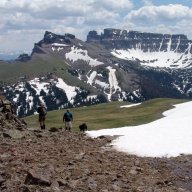
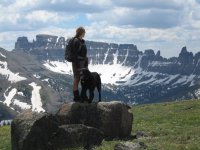
After reading a spectacular trip report on Bear Basin, I knew I had to find a route that went through that spectacular country. This is the biggest contribution I offer and the largest deviation from most traverses. The crux of the entire traverse is getting from Titcomb Basin to upper Tourist Creek, the start of the off-trail route north through Bear Basin. There are 2 options: 1. Using the Split Mountain Pass route to Scott Lake, or 2. Highline trail all the way down to Three Forks Park, then crossing the Green River to ascend Tourist Creek.
The first option is (likely) technically challenging because of having to descend Mammoth Glacier to Scott Lake. That is the route I'm going to try this summer--the most direct route. Option 2 is guaranteed not to have technicalities (class 2-3), but requires a significant detour and 4000 feet of elevation loss and gain.
I just thought I'd throw my ideas out there. Let me know if you have any questions of other ideas! Thank you.







 and over to Bear Basin......