Navigation
Install the app
How to install the app on iOS
Follow along with the video below to see how to install our site as a web app on your home screen.
Note: This feature may not be available in some browsers.
More options
Style variation

You are using an out of date browser. It may not display this or other websites correctly.
You should upgrade or use an alternative browser.
You should upgrade or use an alternative browser.
DIY Gear
- Thread starter steve
- Start date


- Joined
- Jul 23, 2013
- Messages
- 1,666
Alright...here's the hammock project I put together last year, using materials and part purchased almost exclusively from diygearsupply.com. Using only pictures I found online, I patterned it after a type of hammock called the "SwitchBack" from Tree to Trail Trail Gear.
Standard Mode. There are 2 D-rings sewn into each side for getting a better spread and more stable lay. I usually just take one out on opposite sides where my head and feet lay.
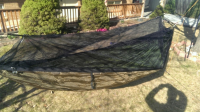
I forgot to take a shot of the bug net fully suspended, so here's a copy of an image from Tree to Trail Gear showing what it looks like with the net fully unzipped on both sides and tied up.

Traditional Mode. The hammock can be flipped over for a more casual lay.
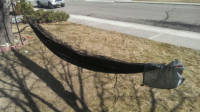
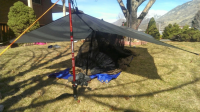
Storm Mode. With DIY tarp.
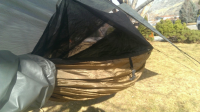
This whole set up was tested successfully in some very strong winds and a bit of rain last year. I was worried the wind would blow the rain up and under since there isn't a whole lot of coverage down the sides. Luckily it wasn't prolonged heavy rain, or else I may have been wishing for a bigger tarp. I still have reservations about it providing enough coverage in heavier storms so I am going to be saving up to get a cuben fiber hex tarp that will offer far more coverage at less than half the weight of silnylon. Or I may just make myself one of those as well, soon as I can afford the material.
Suspension.

I use 1 inch polyester tree straps I made with a simple Marlin Spike Hitch and MSR Mini Groundhog stake for my toggle.
Bishop Bag.
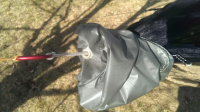
I used some left over silnylon from my tarp to make the bishop bag for storing the hammock. It allows the hammock to bet set up and taken down without the hammock every having to touch the ground. This is especially handy in muddy and wet conditions! I also made whoopie slings out of dynaglide, some continuous loops out amsteel threaded through my end channels, and aluminum rings to connect the whoopie sling with amsteel. In theory, the ring will also serve as a drip break.
Moving into the interior now...
D-rings sewn into each end. I typically clip my clothing bag on one end for a pillow.
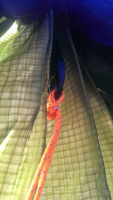
Storage pocket sewn along one side at each end.
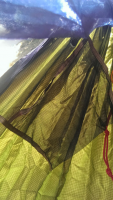
Double Layered with velcro tabs to securely hold a pad. Typically a simple, light, large, and inexpensive windshield reflector.
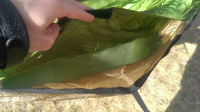
And finally, it maintains the versatility of being able to go to ground as a bivy. Tarp is optional. Due to the delicate fabric used on the hammock though, I have a cheap backpacker tarp from Walmart that I take along to serve as a ground cloth in case I suspect the possibility of no good trees to hang from. When there are trees, it serves as a great foot-mat keeping the socks and feet clean when changing and for other purposes. However, I'm considering replacing it with some tyvek.
Ground Mode.
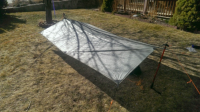
It takes some careful crawling and shimmying to get in with the tarp overhead but once in, it's not bad. Again, I have reservations about how well it would hold out in a storm with high winds and heavy rains. I'm hoping with the extra coverage a hex tarp would give, that would be resolved and I could also give myself some more head space for easier access when on the ground.
While it certainly won't qualify as an ultralight shelter system, it is still remarkably lightweight compared to a number of other hammock systems and other solo shelter products.
Total weight of hammock with suspension & 4 reflective guylines: 2 lb 2 oz
Total weight of tarp w/ ridgeline rope (currently paracord) & 8 reflective guy lines: 1 lb 4 oz
Total weight of 8 MSR mini groundhog stakes: 3 oz
Total weight of entire system: 3 lb 9 oz
Despite all the versatility it offers, if I'm going down into the deserts and canyons and on a route I know that good trees will be sparse to non-existent, then I will opt for a ultralight tent (when I can get one) or tarp as I transition into lighter weight set ups for the easier access and added space they provide on the ground.
Standard Mode. There are 2 D-rings sewn into each side for getting a better spread and more stable lay. I usually just take one out on opposite sides where my head and feet lay.
I forgot to take a shot of the bug net fully suspended, so here's a copy of an image from Tree to Trail Gear showing what it looks like with the net fully unzipped on both sides and tied up.
Traditional Mode. The hammock can be flipped over for a more casual lay.
Storm Mode. With DIY tarp.
This whole set up was tested successfully in some very strong winds and a bit of rain last year. I was worried the wind would blow the rain up and under since there isn't a whole lot of coverage down the sides. Luckily it wasn't prolonged heavy rain, or else I may have been wishing for a bigger tarp. I still have reservations about it providing enough coverage in heavier storms so I am going to be saving up to get a cuben fiber hex tarp that will offer far more coverage at less than half the weight of silnylon. Or I may just make myself one of those as well, soon as I can afford the material.
Suspension.
I use 1 inch polyester tree straps I made with a simple Marlin Spike Hitch and MSR Mini Groundhog stake for my toggle.
Bishop Bag.
I used some left over silnylon from my tarp to make the bishop bag for storing the hammock. It allows the hammock to bet set up and taken down without the hammock every having to touch the ground. This is especially handy in muddy and wet conditions! I also made whoopie slings out of dynaglide, some continuous loops out amsteel threaded through my end channels, and aluminum rings to connect the whoopie sling with amsteel. In theory, the ring will also serve as a drip break.
Moving into the interior now...
D-rings sewn into each end. I typically clip my clothing bag on one end for a pillow.
Storage pocket sewn along one side at each end.
Double Layered with velcro tabs to securely hold a pad. Typically a simple, light, large, and inexpensive windshield reflector.
And finally, it maintains the versatility of being able to go to ground as a bivy. Tarp is optional. Due to the delicate fabric used on the hammock though, I have a cheap backpacker tarp from Walmart that I take along to serve as a ground cloth in case I suspect the possibility of no good trees to hang from. When there are trees, it serves as a great foot-mat keeping the socks and feet clean when changing and for other purposes. However, I'm considering replacing it with some tyvek.
Ground Mode.
It takes some careful crawling and shimmying to get in with the tarp overhead but once in, it's not bad. Again, I have reservations about how well it would hold out in a storm with high winds and heavy rains. I'm hoping with the extra coverage a hex tarp would give, that would be resolved and I could also give myself some more head space for easier access when on the ground.
While it certainly won't qualify as an ultralight shelter system, it is still remarkably lightweight compared to a number of other hammock systems and other solo shelter products.
Total weight of hammock with suspension & 4 reflective guylines: 2 lb 2 oz
Total weight of tarp w/ ridgeline rope (currently paracord) & 8 reflective guy lines: 1 lb 4 oz
Total weight of 8 MSR mini groundhog stakes: 3 oz
Total weight of entire system: 3 lb 9 oz
Despite all the versatility it offers, if I'm going down into the deserts and canyons and on a route I know that good trees will be sparse to non-existent, then I will opt for a ultralight tent (when I can get one) or tarp as I transition into lighter weight set ups for the easier access and added space they provide on the ground.
Last edited:
- Joined
- Aug 9, 2007
- Messages
- 12,967
An older thread that has some info on the subject: http://backcountrypost.com/threads/diy-backpacking-gear-what-do-you-use.36/
- Joined
- Jul 23, 2013
- Messages
- 1,666
An older thread that has some info on the subject: http://backcountrypost.com/threads/diy-backpacking-gear-what-do-you-use.36/
Awesome. Added to my watch list. Do you want to consolidate them to eliminate the redundancy?
- Joined
- Aug 9, 2007
- Messages
- 12,967
feel free to merge them Nick. My apologies for starting a duplicate thread.
No worries!
My favorite and most used is my DIY gravity filter bag for a Sawyer Squeeze. One trip to the creek and I have water for the night and next morning. I think it's a 13 Liter Sea to Summit dry bag. I walked the aisles at Ace Hardware finding the tubing and fittings to hook it up. Weighs less than the platypus 3 Liter bladder I was using and hold much more.
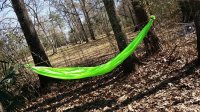
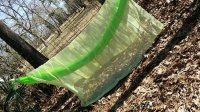
Nice job. I like the bright hammock. All of mine are brown or earth tones. I have had trouble finding my hammock after a 2AM pee break.View attachment 26260View attachment 26261my first diy hammock, my first hammock period. Just attached whoopie slings couple days ago. Working on bug netting.
rtavious
Member
- Joined
- Feb 1, 2015
- Messages
- 28
Thanks.... that wasnt my original intention. But after id out it up for first time . It occured to me that camp will be easier to find. Lol I think i will go bright on tarp to idk yet.Nice job. I like the bright hammock. All of mine are brown or earth tones. I have had trouble finding my hammock after a 2AM pee break.